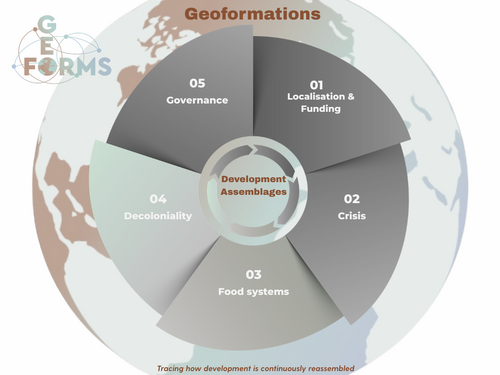
Prepared by: Geoformations team (https://geoformations.eu)
Maeve McGandy, Researcher, Cynthia Mwende, Research Assistant, Ruby Paterson, PhD Scholar, and Susan Murphy, Principal Investigator.
At a moment when the field of development appears to be in flux, the Development Studies Association of Ireland’s (DSAI) recent conference offered more than just a snapshot of current debates in development studies. Across the conference, discussions resonated with our own ongoing work, reinforcing a shared understanding within the Geoformations team: that development is no longer organised around stable or enduring institutions, ideas of continuous material progress, or clearly defined and identifiable sets of actors. Instead, it is continually being disassembled (unmade) and reassembled (remade) through ever-shifting relations of power, finance, knowledge, and practice.
For us, the conference was less about arriving at solutions than about opening space to think with, and through, these processes across diverse geographies, sectors, and analytical entry points. This post-conference reflection does not aim to be exhaustive, instead offering a partial snapshot of the conversations that stayed with us, highlighting several themes that have informed our ongoing thinking.
Localisation, power and the limits of rhetoric:
A session on localisation and locally led development spoke directly to debates we have been exploring within Geoformations. Participants – academics and practitioners alike – interrogated what many saw as the superficial adoption of localisation discourse, asking what, if anything, has materially changed in terms of power, decision-making, authority, and resource control. For many, localisation was seen to be inseparable from questions of decolonisation, yet this connection was understood to be absent from its practical application. As one practitioner observed, without confronting historical and structural inequalities, localisation risks becoming little more than a technical adjustment rather than a political transformation. As another participant put it, localisation must begin by asking “what matters to you?” rather than “what is the matter with you?”
Participants repeatedly questioned who defines effectiveness, whose knowledge is prioritised, and why the “majority of people” affected by development interventions are so often rendered minorities within decision-making spaces. From a Geoformations perspective, localisation continues to emerge as a site of ongoing discursive, material, and financial struggle, influenced by donor requirements as well as institutional incentives and priorities.
Contextualising crisis and the development interregnum:
Keynotes from Professors Alfredo Saad Filho (QUB) and Owen Worth (UL) situated development squarely within a broader moment of political, environmental, economic and social crisis. Professor Saad Filho’s analysis of “neoliberal fascism” traced how economic insecurity, authoritarian politics, and social fragmentation are becoming increasingly entangled across both Global North and Global South contexts.
Prof. Owen Worth explicitly mobilised the conference theme, framing contemporary development as unfolding within an interregnum, marked by the collapse of old certainties and the absence of settled alternatives. From this perspective, development cannot be treated as neutral or technical. Rather, as both a process and a set of ideas, it is deeply intertwined with political struggle, legitimacy crises, and competing visions of the future.
These keynote discussions helped us contextualise our own work and echoed a key insight for Geoformations: development has always constituted an inherently political endeavour, shaped by shifting power relations, opaque governance processes, questions of legitimacy, and diverse (often conflicting) aspirations and interests. For us, this recognition opens up necessary space for generative discussion about what development might yet become, and who and what it will serve, particularly in light of its growing complexity.
Food, gender, governance, and power
Another session focused on food crises, emphasising how material resources function as powerful instruments of governance. Through case studies from South Sudan, Ukraine, and Gulf aid interventions, participants showed how food actively reshapes social relations in context by reinforcing or disrupting gender roles and operating simultaneously as humanitarian relief and as a weapon of war.
Across these cases, food systems emerged as relational assemblages linking households, markets, donors, humanitarian agencies, and geopolitical strategies. In Ukraine, food was discussed explicitly as a tool of anti-civilian warfare. Elsewhere, food aid was framed as part of peacebuilding efforts, raising critical questions about responsibility, dependency, and long-term governance.
These discussions underscored the need to move beyond sectoral silos and engage food not simply as sustenance, but as a mechanism of development and humanitarian governance, one that shapes and is shaped by authority, compliance, and contested social orders.
Decolonial entanglements
On day two, Associate Professor Divine Fuh’s keynote offered one of the conference’s most challenging reframings. Development, he argued, “must be reimagined not as 'helping,' but as cohabitation”. Framing development as a condition of global entanglement, he called for a paradigm shift toward an ethic of cohabitation grounded in dignity, mutual capacity, and shared responsibility. “We need to rethink development and avoid distractions,” he insisted, urging us to ask how projects repeatedly intended to transform communities so often end up displacing or marginalising the very people they claim to serve.
Central to this address was the idea of global entanglement, which challenged linear North-South conceptualisations of development and emphasises its multi-directional, historically conditioned character. From this perspective, equitable partnerships cannot exist where capacity-building and intervention remain bounded by hierarchical, one-directional logics.
This framing resonated strongly with our own work, particularly in mapping relations within moments of rupture, underscoring the value of approaches less tethered to hierarchical models and more attuned to relationality, contingency, and power-attentive ways of thinking and writing about development.
Assemblage in practice
These threads came together most clearly in our Geoformations panel on Disassembling and Reassembling Development. Drawing on cases from Tanzania, Costa Rica, Ukraine, and post-aid South-South development contexts, participants reflected on what it means to study development through an assemblage lens amid increasingly fluid, hybrid, and negotiated spheres of governance practice.
Rather than offering closure or neat representations, the panel reinforced the value of staying with complexity and of working within it to illuminate how, while conditioned by wider geopolitical and geoeconomic currents, development governance is often enacted through everyday practices, informal negotiations, and contested partnerships across scales. Localisation, aid effectiveness, budgetary constraints, climate adaptation, and civil society voice appeared not as fixed analytical categories, but as elements of governance assemblages that remain operational while continuously in flux.
Two key learnings emerged from presenter’s insights and audience reflections. The first concerned the practical and ethical implications of conducting research in moments of rupture or active breakage. The second centred on the power dynamics of reflexive practice when making sense of development through assemblages. One audience member, in particular, prompted us to reflect on the implications of tracing governance assemblages, encouraging a shift from description towards questions of “what next?”
Looking ahead
The conference closed with Professor Su-ming Khoo’s call for an expansive and generative, yet radical and necessary, rethinking of education beyond narrow developmental targets. Re-engaging a capabilities approach, she invited us to imagine an education re-rooted in justice, relationality, and planetary responsibility. Her reflections echoed a wider message running throughout the conference: that development today demands critical attentiveness, relational thinking, and ethical humility.
Rather than offering a diagnosis or a new direction, the conference foregrounded the complexity of development as a field of practice. Core themes such as localisation, climate action, food systems, funding, and education cannot be understood as separate domains. Rather, they represent interconnected ideals, mechanisms, and points of intervention within assemblages influenced by unequal power relations, historical legacies, and geoeconomic forces. Efforts to compartmentalise these processes risk reproducing the very exclusions they seek to address.
For Geoformations, the task is not to wait for development to settle into something new, but to situate the current rupture, active as it is, within its broader trajectories, and to attend to its ongoing reconfiguration. Our work, which traces relationships and everyday practices, offers one way of engaging this complexity. In a moment marked by uncertainty and disruption, such attentiveness is not a distraction but a methodological and practical necessity.