Skip to content

back to events listing

DSAI Webinar Series: SDG Challenge - 13 Climate Action

-


Webinar FINAL 27th May 2026

Development Studies Association Ireland (DSAI) Webinar Series on 

Irish Funded Development Research

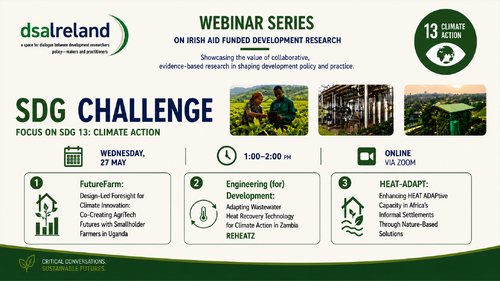
Showcasing the value of collaborative, evidence-based research in shaping development policy and practice, DSAI will host a webinar on Wednesday, 27th May, from 1:00–2:00pm (Irish Standard Time), focusing on SDG Challenge Funded Projects - SDG 13: Climate Action.

Eventbrite Registration Link: To follow

Chair
Assoc. Prof. Susan Murphy, DSAI Chair, Trinity College Dublin

Presentation 1

FutureFarm: The Future of Data-Driven Agriculture in Uganda: A Design-Led Approach to Building Climate-Resilient Futures with Marginalised Smallholder Farmers

Abstract:
Speakers: 
Dr. Annmarie Ryan (University of Limerick)
Dr. Allan Mazimwe (Makerere University)

Presentation 2

Engineering (for) Development: Adapting Wastewater Heat Recovery Technology for Climate Action in Zambia

Abstract: The REHEATZ project (Research Ireland, Irish Aid) is focused on improving energy efficiency and reducing fossil fuel use in Zambian food production to address SDG 13: Climate Action. As part of DSAI’s webinar series, members of the project team will share their findings from this project and their experience working on a development-focused engineering challenge. In particular, differences between previous sustainability projects and the SDG Challenge will be explored, showing the new approaches the engineering team took to working in Zambia and the importance of social impact to the project.
Speakers: 
Prof. Aonghus McNabola (RMIT University)
Prof. Paul Coughlan (Trinity College Dublin)
Ms. Laura Nkhuwa (Southern African Institute for Policy and Research)
Ms. Eleanor Mancusi-Ungaro (Trinity College Dublin)

Presentation 3

HEAT-ADAPT: Enhancing HEAT ADAPTive Capacity in Africa's Informal Settlements Through Nature-Based Solutions

Abstract: HEAT-ADAPT aims to strengthen adaptive capacity to extreme heat in informal settlements of Dar es Salaam through integrated quantitative, qualitative, and transdisciplinary approaches. First, the project will validate and characterize heat stress challenges in informal settlements using mixed-method assessments, including environmental monitoring and community-based inquiry. Second, it will identify and address both technical and non-technical barriers limiting the adoption and integration of green solutions in these settings. Third, the project will iteratively co-create, co-develop, and deploy nature-based cooling interventions—particularly exterior greening strategies and community cooling spaces such as parks—through close collaboration with local stakeholders. Finally, HEAT-ADAPT will evaluate the effectiveness of deployed green infrastructure by measuring indoor and outdoor cooling performance under current and projected future climates, including surface temperature reduction and co-benefits such as food provision. The project seeks to generate scalable, community-informed solutions that enhance thermal resilience while delivering environmental and social co-benefits.
Speaker: 
Asst. Prof. Tobi Eniolu Morakinyo (Texax A&M University)

Followed by a Q&A Session

Speaker Biographies:

Dr. Annmarie Ryan 

Dr. Allan Mazimwe 

Prof. Aonghus McNabola is the Deputy Dean International and Professor of Energy and Environmental Engineering at RMIT University in Melbourne, Australia, and co-PI on the REHEATZ project. Previously, he was a professor and head of department in Civil, Structural, and Environmental Engineering at Trinity College Dublin, where he led a number of collaborative projects on air pollution and energy recovery. His research addresses SDGs 13 (Climate Action),11(Sustainable Cities and Communities), 6 (Clean Water and Sanitation), 7 (Affordable and Clean Energy), and 9 (Industry, Innovation and Infrastructure).

Prof. Paul Coughlan is a Fellow Emeritus at Trinity College Dublin, Ireland. His research explores collaborative strategic improvement of operations through network action learning. His fellow researchers are in different domains and in practice, both nationally and internationally. He has contributed actively to funded research projects exploring environmental sustainability of water use and distribution, manufacturing improvement, and innovation in food production.

Ms. Laura Nkhuwa is a researcher at the Southern African Institute for Policy and Research and a PhD candidate at the University of Zambia in Climate Change and Sustainability Education. Her work on the REHEATZ project focuses on social and societal impact, where she brings experience from her previous work with the UNDP, the Zambian Centre for Environment Justice, and TIMESIS.

Ms. Eleanor Mancusi-Ungaro is a researcher in Civil, Structural, and Environmental Engineering on the REHEATZ project. Through REHEATZ, she works on analysis of heat recovery systems, their associated carbon savings, and their potential for wider adoption, as well as green policy initiatives that could support energy efficiency installations in Zambia.

Asst. Prof. Tobi Eniolu Morakinyo is an urban climatologist and bioclimatologist. Over the past decade, his research has explored the interaction between urban land use and human stress in a changing climate and the role of green infrastructure in enhancing urban adaptive capacity. More recently, his work has expanded to understanding heat-health relationships in sub-Saharan Africa using geospatial technologies and open climate data to support multi-level heat adaptation planning for African cities. He is the Co-Lead PI a SDG-Challenge project, HEAT-ADAPT: Enhancing HEAT ADAPTive capacity in Africa’s informal settlements with nature-based solutions.

Back to top