Book Review by Dr Nita Mishra | Dept of Politics & Public Administration | University of Limerick
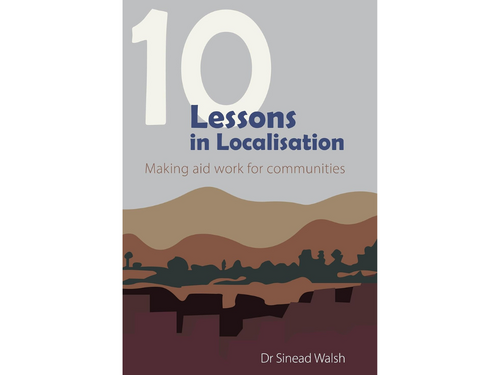
Walsh, Sinead. 2025. 10 Lessons in Localisation. Making aid work for communities. UK: Practical Action Publishing
Localisation has become one of the key buzzwords in international development policies globally. Conferences ensure the word ‘local’ is in their titles. International non-government organisations (INGOs) announce localisation as core to their development interventions. However, the concept itself, and strategies to achieve ‘localisation’ vary within, and between, different organisations. For a detailed discussion on the localisation discourse, see selected recent texts1 below. Defining the ‘local’ is a tricky proposition and this can be heavily influenced by donor aid agendas.
Walsh’s ten lessons draw on her extensive work as a development practitioner with NGOs, donor agencies, in different countries over two decades, and her doctoral research on INGO accountability to communities. Her international roles at policy making levels, especially on climate issues, globally enrich the discussions in the book. Her honest account of imperfections noted in Action Aid International’s (AAI) ‘Accountability Learning and Planning System’ (ALPS) is commendable also because of the support that AAI provided despite the critique. All were in the learning process together. And this is the core takeaway for me, in this book.
While the reader can get detailed description of the lessons, I wanted to focus on key insights which I find radical with path-breaking statements which Irish NGOs must take cognizance of. Dr Walsh does not hesitate to write that international staff members have a vested interest in maintaining the status quo to ensure their (well-paid) job security (see page 23). Having worked in the sector, I second the claim to a great extent. She further reveals how she ‘got a lot of pushbacks from other international NGOs’ to her presentation on ‘When Partnership Goes Wrong’ (p.23) wondering how can work progress if there are no open discussions on the unintended impact of development programmes. Linked to the partnership issue is who represents the communities because ‘there is nothing uniform or unitary of a group of people who simply happen to live in the same locality’ (p. 55). Community representatives might be serving individual/ party vested interests. This was evident from her experience in Uganda.
The observation that people find themselves vulnerable in spite of the opposite claimed by INGOs is very revealing: ‘The vulnerable we don’t have power, we fear that assistance will be withdrawn’ (p. 68). Thus accountability, especially sharing information on budgets, was in question in addition to not considering people’s time constraints while deciding on trainings etc. Walsh’s critical lens to development aid does not end here. Using other development workers/scholars works (Scott-Smith 20132; Watkins et al 20123; Cornwall & Brock 20054; etc.,), she analyses how Aidland tended to ‘learn the language and rattle away’ (p.104) with no real transformation at the ground level. Trend-setting is another concept which Walsh (p.74) delves deeper into weaving evidence-based arguments with works of earlier scholars (‘relentless emphasis on novelty and change’, Lewis 2013: 116-1175; ‘continuity of discontinuity’, Sogge 1996: 166). Lesson 6, thus, states that ‘trend-jumping undermines the potential for localisation’ because with change in the upper echelons of a donor agency leads to changing priorities at the local level leaving community workers baffled.
I will leave it here and hope it whets the reader’s appetite for more. Dr Walsh’s book is not only a ‘must read’ for thoseleading and making policies for development practice globally, but also to reflect deeper, using a critical lens, on how genuine localisation has the possibility of real transformation on the ground. It also provides a much needed relief to community level development practitioners to see that donor agencies are ready to acknowledge and act upon their own shortcomings.
_____________________________________________________________
1 Koch, D. J., & Rooden, A. (2024). Understanding and addressing the unintended effects of aid localisation. Development in Practice, 34(3), 351–363. https://doi.org/10.1080/09614524.2024.2303666
Lie, J.H.S., 2022. The localisation of aid-debate and challenges. Policy Brief; du Pont, Y., 2025. The Localisation of Aid: Acceleration or Re-centralisation in Times of Disruption?. International Journal for Humanitarian Studies, 6(4), pp.18-24; Mulder, F., 2023. The paradox ofexternally driven localisation: a case study on how local actors manage the contradictory legitimacy requirements of top-down bottom-up aid. Journal of International Humanitarian Action, 8(1), p.7; Amankwa, M.O., Amponsah, C., Adusei-Asante, K., Banham, V.F. and Brempong, P.N.A., 2025. ‘Rhetorics or business as usual?’A systematic review of the realities of Australian aid localisation efforts in the Pacific region. International Politics, pp.1-24; Savard, M.C., 2025. Reinstating the political in localisation. Development in Practice, pp.1-13; van Selm, G., Bukenya, B., Kamya, I., Kumi, E., Yeboah, T., Banks, N., Elbers, W., Schulpen, L. and van Wessel, M., 2025. Northern NGO-centrism inlocalisation processes: reproducing power inequities in the aid field. Development in Practice, pp.1-11.
2 Scott-Smith, T. 2013. ‘The struggle for organisational change: How the Actionaid Accountability, Learning and Planning System emerged’, Development in Practice, 12(3&4), pp. 424-435.
3 Watkins, S.C., Swindler, A. and Hannan, T. 2012. ‘Outsourcing Social Transformation: Development NGOs as Organisations’, Annual Review of Sociology, 38, pp. 285-315
4 Cornwall, A., & Brock, K. (2005). ‘What do buzzwords do for development policy? a critical look at ‘participation’, ‘empowerment’ and ‘poverty reduction.’ Third World Quarterly, 26(7), 1043–1060. https://doi.org/10.1080/01436590500235603
5 Lewis, David. 2013. ‘Reconnecting development policy, people and history’, in T.Wallace and F.Porter (eds) Aid, NGOs and the Realities of Women’s Lives, Rugby: Practical Action Publishing
6 Sogge, D. 1996. ‘Settings and Choices’, in D.Sogge (ed) Compassion and Calculation: The Business of Private Foreign Aid. London: Pluto Press.