DSAI Gender Study Group, Dept of Geography, TCD and the World Bank Group
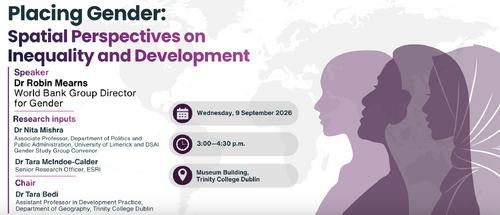
Placing Gender: Spatial Perspectives on Inequality and Development
September 9, 2026
An Oblique Report
By Connell Foley
This event was hosted by the Department of Geography at Trinity College Dublin and co-convened with the DSAI Gender Study Group and the World Bank Group.
Agenda:
Dr Robin Mearns, the World Bank Group's Director for Gender, to open with a brief reflection on his own journey from studying geography and development to leading the World Bank Group's gender agenda, before turning to the substantive focus of the session, the WBG's gender research, strategy, and impact, including its gender targets and the connection between gender equality and the jobs agenda.
Two research inputs from:
Dr Nita Mishra (Associate Professor in the Department of Politics and Public Administration at the University of Limerick and Convenor of the DSAI Gender Study Group) and
Dr Tara McIndoe-Calder (Senior Research Officer at the ESRI and Chair of the Irish Society for Women in Economics).
The session was chaired by Dr Tara Bedi (Assistant Professor in Development Practice in the Department of Geography at Trinity College Dublin).
The primary speaker was Robin Mearns (World Bank Group), an ex-Geographer [can you ever leave?] who moved to Development Studies and now leads the Gender Strategy for the World Bank Group.
Robin suggested that he was most interested in the political economy of the environment and development with a gender lens. Central to this is what he called “marginality produced by institutions of power” leading him to question environmental as well as other orthodoxies and trying to develop “critiques from the sidelines” on how to do development better.
He outlined his journey in development, which included the well-known Sustainable Livelihoods Programme, before moving to the World Bank and the Social Policy Unit. This move was motivated by wanting to “stop critiquing” and put into practice his knowledge and skills and “do project work”. He witnessed a huge effort to maintain GBV prevention, mitigation and response. He noted World Bank reforms in 2025-2026 with an emphasis on data-driven strategies [it begs the question as to what previous strategies were based on!]. He also noted the remit of the strategy covering not just the public sector but the private sector too.
Nita Mishra outlined her own research interests that included women (“not gender”), rights and empowerment. She believes that women see that they have agency and can negotiate for themselves. Nita repeated that she questioned a “Eurocentric” view of gender.
She also outlined how she feels that research methods influence outcomes and believes in arts-based methods, including the expression of marginal voices through poetry.
Tara McIndoe-Calder came very much from the perspective of the Irish Society for Women in Economics. She talked of their principles and their focus on measuring outcomes in public services. She focused on the challenge of achieving equality and gender diversity in different groups, noting that there had never been a female governor of a Central Bank in Europe (acknowledging Christine Lagarde). She said that economists now realise the challenge of heterogeneity and diversity of thinking, noting also that “all macro- is micro-informed now”.
In the Q&A session, there was some discussion on the World Bank’s focus on jobs and industrial policy, and then Robin outlined the core of the World Bank Group’s Gender Strategy. It comprises three central pillars: a) elevating human capital and ending GBV; b) economic opportunities for women and female entrepreneurship; and c) engaging women as leaders, looking for development outcomes from women’s leadership. He noted the difficulty of achieving the right balance of depth with scale/reach, the latter of which should be ambitious. They had no target numbers for the pillars in the strategy although he said that they had an array of metrics down in operational plans.
He suggested that what was important was to motivate leaders to invest in systems strengthening through transformative lending from the WB. While achieving women’s empowerment and an equitable care agenda were challenging, he said that there were plenty of small pilots becoming institutionalised. Tara noted that there was evidence that women’s (formal workplace) productivity was lower post-childbirth for a variety of reasons. Nita noted that it is women who deliver the SDGs at village level, that traditional roles still exist and that the fourth burden of development is on women and that they have huge power in that sense. She also noted that employment gave women prestige. Finally, Robin acknowledged that the pillars of the WB strategy had to be accompanied by changes in social norms and behaviour change; he cited the example of Brazil where the school curriculum was trying to plant the seeds of gender equality.
And so to outcomes or, at the least, outputs? The “so what?” What are the takeaways?
As with most of these kinds of seminars or sessions, I am looking for something that might change my attitudes or practices, or at the least, for insights, for pinpricks of illumination that might inform future action. These are often elusive or seem important and fresh in the moment but evaporate over time. I suppose that it added to the ‘heterogeneity’ of my thinking, absorbing different perspectives. Beyond that, it is hard to see. As a (an ex-) practitioner, how would this change my practice? I do not see it although in the course of how one expresses oneself, one is more sensitive to other perspectives. That can be positive or inhibiting….
As usual, I find myself struck by certain phrases, in this case, “marginality caused by the institutions of power” and “critiques from the sidelines”.
The challenge for DSAI is probably how to bring the critiques from the sidelines and in to the field. As the Grateful Dead might phrase it, that is likely to be a “long strange trip”!