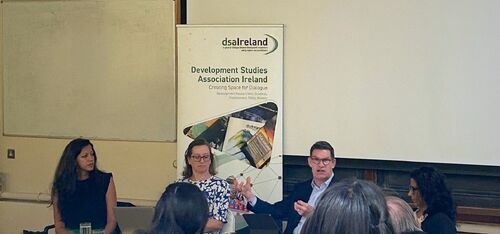
On 9 September 2026, Placing Gender: Spatial Perspectives on Inequality and Development took place at Trinity College Dublin, hosted by the Department of Geography and co-convened with the Development Studies Association Ireland (DSAI) and the World Bank Group.
The session brought together Dr Robin Mearns, World Bank Group Director for Gender; Dr Nita Mishra, Department of Politics and Public Administration, University of Limerick; and Dr Tara McIndoe-Calder, Senior Research Officer at ESRI. The session was chaired by Dr Tara Bedi, Department of Geography, Trinity College Dublin.
Session Overview
Gender, inequality, and development are among the most relevant topics in today’s world, and this shaped the discussion at “Placing Gender: Spatial Perspectives on Inequality and Development,” hosted by Trinity’s Department of Geography on Wednesday 9 September. Dr Robin Mearns, the World Bank Group’s Director for Gender, opened with a reflection on his career trajectory from geographer to practitioner, touching on highlights such as his early work on Mongolia’s first land law, and later, within the World Bank’s Social Development department, on shaping an agenda for local responses to climate change. He went on to speak about his development projects across South Asia and Africa, and the strategies and policies he helped shape to build infrastructure and insurance and support countries’ self-sufficiency, underlining that gender is not a side issue but central to every project and touches all of the Bank’s work. He then linked this to the current jobs agenda strategy of the World Bank.
Dr Nita Mishra spoke next, drawing on her research with women in Vietnam. Her point was that women want to decide for themselves what kind of work they engage in. Where a woman takes on flexible domestic work over stable income, Dr Mishra argued this is often driven by other demands and factors in her life, rather than a lack of options, and that the choice should be hers to make rather than decided for her. She extended the conversation on gender beyond a male or female binary, and addressed racism, minorities, and how women’s rights are treated differently across countries, alongside her interest in collecting data in different ways, using more artistic approaches. Dr Mearns pointed to the World Bank’s work with the LGBTQ2+ community in Brazil. Dr Tara McIndoe-Calder then spoke about her work as chair of the Irish Society for Women in Economics (ISWE), founded in 2021, which supports women’s representation and inspires women to study and excel in economics. Because ISWE was founded later than comparable societies abroad, she noted it has had the chance to learn from them. Drawing on ISWE’s recent conference on diversity, she highlighted how career trajectories diverge after childbirth, evident in commuting patterns, fathers’ commutes tend to lengthen as they look further afield for higher paying jobs, while mothers’ commutes tend to shorten as they prioritise proximity to home and to running the household.
The session closed with questions on industrial policy, the jobs agenda, where gender fits within it, and how the jobs agenda can support care.
Key Points
- Dr Mearns traced his path from geographer to World Bank practitioner. He pointed to early work supporting Mongolia’s first land law, and later, while in the Bank’s social development department, to shaping its agenda on local responses to climate change.
- A recurring theme in Dr Mearns’s talk was about who is at the table when development and gender agendas are shaped, and who gets a say.
- Dr Mishra framed her research with women in Vietnam around agency. Her point was that women want to decide for themselves what kind of work they engage in, where a woman chooses flexible domestic work over stable income, this often reflects other demands and factors in her life, not a lack of options, and that choice should be hers to make, rather than decided for her.
- The discussion repeatedly returned to the tension between care and paid work. Dr McIndoe-Calder’s points from the recent ISWE conference highlighted this, she flagged a finding from the conference that found fathers’ commutes tend to lengthen after childbirth as they look further afield for higher paying jobs, while mothers’ commutes tend to shorten as they prioritise proximity to home to manage the dual responsibilities of work and caregiving, evidence of how care still falls unevenly and shapes women’s choices in the labour market.
- A related concern raised was the risk of marginalisation, particularly in how the jobs agenda is being designed and who it may leave out.
Key Takeaway
Gender runs through development work across sectors, from land and climate to jobs and care. Progress depends on structural factors, such as commuting patterns, career flexibility and access to services, not just headline commitments.