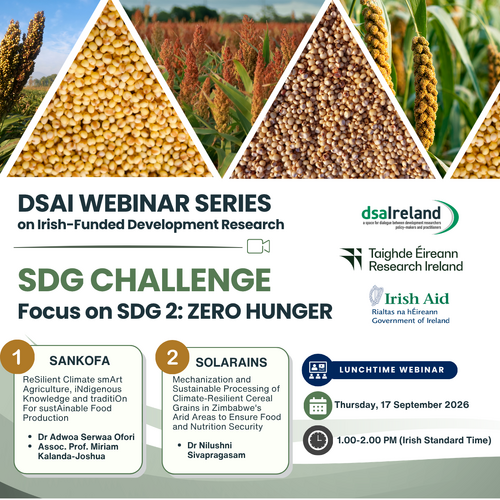
This DSAI lunchtime webinar, part of the Research Symposium on Irish-Funded Development Research, showcased two projects funded through the SDG Challenge, a partnership between Research Ireland and Irish Aid. Focusing on SDG 2: Zero Hunger, the session explored climate-resilient agriculture, sustainable food processing, and food and nutrition security in Malawi and Zimbabwe.
Thursday, 17 September 2026
1.00–2.00 p.m (Irish Standard Time)
Online
Presentation 1
SANKOFA: ReSilient Climate smArt Agriculture, iNdigenous Knowledge and traditiOn For sustAinable Food Production
The impacts of climate change and variability pose significant challenges to food security in Malawi, a predominantly agrarian nation heavily reliant on rain-fed agriculture. A key issue is how rural smallholder farmers can adapt to these changes to safeguard their food security, improve agricultural productivity, promote sustainable food production, and build resilience in their farming practices. This project aims to address these challenges by integrating indigenous knowledge with climate-smart agricultural technologies through co-creation with rural smallholder farmers. What makes this project unique is its blend of traditional, indigenous practices – in essence SANKOFA, an African concept translated ‘go back and take it’; meaning ‘there is wisdom in learning from the past’ – with scientific approaches, helping farmers select the most effective combination of these methods to secure their food supply amid changing conditions. This approach has the potential to improve the lives and livelihoods of smallholder farmers, women, and rural communities by introducing innovative farming techniques that can boost yields (supporting SDG 2) and increase income (supporting SDGs 5 and 10). In the first six months, efforts will focus on engaging stakeholders and evaluating the proposed solutions, with the following twelve months dedicated to their practical implementation.
Principal Investigator: Dr. Adwoa Ofori; School of Agriculture and Food Science, University College Dublin.
Partner Country Team Lead: Assoc. Prof. Miriam Kalanda-Joshua; Department of Geography and Earth Sciences, University of Malawi.
Presentation 2
Solarains: Mechanization and Sustainable Processing of Climate-Resilient Cereal Grains in Zimbabwe’s Arid Areas to Ensure Food and Nutrition Security
The Challenge: Processing of climate-smart cereal grain (sorghum and millet) in Zimbabwe is dominated by manual, labour-intensive methods such as hand threshing and pounding. These outdated practices are time-consuming, inefficient, and place a heavy burden on women and girls, limiting their time for education and income-generating activities. Despite being climate resilient, the adoption of these cereal grains remains low due to the lack of affordable, off-grid mechanised technologies suited to rural smallholders. This results in high postharvest losses, poor grain quality, and reduced market value. Addressing this challenge through appropriate mechanisation can improve efficiency, reduce drudgery, and enhance food security, livelihoods, and gender equity in climate-vulnerable communities.
The Solution: This project proposes the design and local production of a solar-powered, integrated sorghum thresher and roaster tailored for rural Zimbabwe. The unit will combine threshing, dehulling, and roasting functions to streamline postharvest processing, reduce labour burden, and minimise losses. Powered by solar energy, the technology is off-grid, environmentally friendly, and cost-effective, ideal for remote, low-resource settings. The equipment will be gender-responsive, easy to operate, and built using locally available materials to ensure sustainability and scalability. By mechanising sorghum processing, the solution will unlock productivity, enhance grain quality, and promote inclusive, climate-resilient food systems in smallholder farming communities.
Project Lead: Dr Nilushni Sivapragasam, University College Cork
______________________________________________________________________
Speaker Biographies
Dr. Adwoa Ofori; School of Agriculture and Food Science, University College Dublin
Adwoa Ofori is a researcher with interests in sustainable rural and African development. She has a background in human geography and project management. She has previously worked on research projects on rural digitalisation and urban water quality. She is the Principal Investigator on the SANKOFA project – a Research Ireland funded SDG Zero Hunger Challenge – which focuses on blending traditional, indigenous practices with scientific approaches to address food security impacts of climate change in rural Malawi.
Assoc. Prof. Miriam Kalanda-Joshua; Department of Geography and Earth Sciences, University of Malawi
Miriam Dalitso Kalanda Joshua is an Associate Professor in Geography and Head of Geography and Earth Sciences Department at the University of Malawi. She is a member of AGNES - a regional network of African Group of scientists/ experts in various disciplines but with special interest in climate change issues. She is also a Climate Change Champion on policy and advocacy in Africa for the Food, Agriculture and Natural Resources Policy Analysis Network.
Dr Nilushni Sivapragasam, University College Cork
Dr Sivapragasam is a Lecturer in Innovative Food Transformation in the School of Food and Nutritional Sciences, UCC, since July 2024. She previously worked as a postdoctoral researcher at the University of Wisconsin-Madison, USA and United Arab Emirates University, UAE focusing on extracting biomacromolecules and bioactive molecules from dairy and agricultural side streams. She obtained her MSc and PhD in Physical Chemistry at North Dakota State University, USA in understanding of the surface chemistry of biomaterials and carbon nanomaterials. Since joining UCC, Dr Sivapragasam has secured several funds as a PI and Co-PI through Research Ireland, Irish Aid, and DAFM to work on transforming food, agriculture, and marine side streams to value-added biomaterials that can be used as bioactive packaging materials and bio-composites. Furthermore, her work focuses on mechanising the value chain of climate-resilient crops in rural Africa, while advancing sustainable food systems to address and mitigate malnutrition. Dr Sivapragasam is a member of The Irish Packaging Society (TIPS) and has earned IOM3 accredited Certificate in Sustainable Packaging materials.